
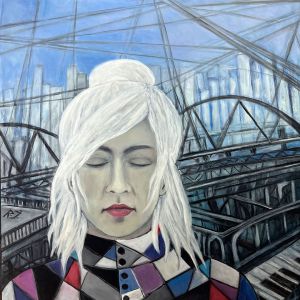
Sina Berlinski (geb. Goldfein)
b. 1910 | Warsaw – d. 2011 | Washington
Sina Berlinski was born in Warsaw in 1910 but grew up in Leipzig from early childhood. The family lived on Sedanstraße (today Feuerbachstraße) in the Rosenthal district. Sina’s great passion was singing and music. She attended the synagogue on Keilstraße less for religious reasons than for the music; the warm baritone voice of the cantor Hillel Schneider particularly impressed her. At the Ephraim-Carlebach School, her striking interest in music was encouraged by her music teacher Samuel Lampel. Sina became familiar with numerous folk and art songs. The musical atmosphere of Leipzig left a lasting impression on her: she enthusiastically listened to the St. Thomas Boys Choir and sang in the Gewandhaus Choir, conducted by Thomaskantor Karl Straube. In 1928, she began studying piano at the Leipzig State Conservatory under Robert Teichmüller, completing her studies in 1931. Her interest lay especially in song accompaniment and chamber music, but these focuses were only given limited consideration in her training, which she always deeply regretted.
In a time of political and social change, she lived in Leipzig after her graduation from occasional musical jobs—and with the Nazi seizure of power, her professional prospects abruptly ended. Her friend Hermann Berlinski, also a conservatory graduate, left Leipzig for Poland as early as March 1933; Sina followed him in 1934. Via Danzig, they fled by sea to Belgium, then to the Netherlands, and finally to France, where they married in Paris. Both resumed their studies and tried to build a new existence. With the invasion of German troops into France, they once again faced mortal danger. They managed to escape across the Pyrenees to Spain; from Bilbao, they reached New York in 1941. In the USA, they had to cope with an entirely new daily life—a challenge that often pushed both of them to their limits. In 1942, their son David was born, who later worked as a mathematician, philosopher, and author. In 1963, the family moved to Washington, D.C. There, Sina found the professional fulfillment she had always sought: she worked intensively with singers, developed interpretive concepts, and taught pianists at the Catholic University who specialized in song accompaniment and coaching. Her work as an educator built upon the musical influences and experiences she had gained in her youth in Leipzig.
In 1981, she returned to Leipzig for the first time with her husband. The visit to her former home in the Waldstraßenviertel was particularly moving for her. Her father had remained in Leipzig and was deported to Auschwitz during the Nazi persecution.