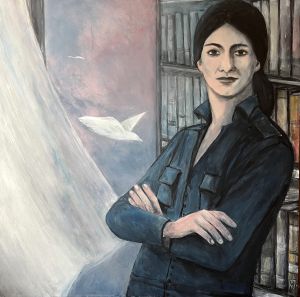
Anna Elisabeth Charlotte Simoni
30 August 1916 | Leipzig – 8 January 2007 | Dorset, UK
Librarian and linguist
Anna Simoni was born in Gohlis in the midst of the First World War, the youngest child and only daughter of Jewish parents – both of whom were born in Leipzig. In 1917, the Simoni family moved to Rybnik in what was then Upper Silesia. In 1923, they returned to Leipzig. Her father worked at Max Ariowitsch’s tobacco company. From Easter 1926, Anna attended the Rudolf-Hildebrand-Oberschule in Connewitz. Her favourite pastimes were reading in various languages, travelling and hiking; she was very close to nature and had many friends. Even as a child, she wrote imaginative letters and took a keen interest in the work of her uncle Berthold Finkelstein – who, well into old age, translated the works of Nobel Prize winners in Chemistry, including Marie Curie, into German.
When the National Socialists seized power in Germany in 1933, Anna was just able to sit her A-levels in March 1935 – but she could no longer go on to university. She fled Germany for Italy – where, alongside literature, she studied German and English – and later added history and Romance languages to her studies – taking courses in art history, music history, archaeology and philosophy. In the autumn of 1938, the situation for Jewish people in Fascist Italy deteriorated drastically – and Anna fled to England. At the University of Glasgow, she completed her studies in 1941, graduating with a ‘Master of Arts’ degree with distinction. After undertaking postgraduate studies in Greek, the 26-year-old enlisted in the Royal Air Force in the summer of 1943. She worked as an aircraft mechanic, rising to the rank of sergeant as a ‘Leading Aircraft Woman’. Upon her demobilisation in 1946, she was certified as follows: ‘Sgt. Simoni is exceptionally well qualified and serves as a specialist teacher of classical and modern languages.’
In 1948, she was granted British citizenship. In the library of the British Museum – one of the world’s most important libraries – Anna found her life’s work. Although she had studied many languages, but not Dutch, she was given the opportunity to build up the collection of Dutch-language books in a dedicated section. She became a mentor to generations of young book historians, whom she guided enthusiastically through the collections and with whom she often maintained lifelong ties. Even after her retirement, she continued to work regularly at the British Library right up until 2007.
NOTE: *) The biographical details above had to be abridged for the purposes of the exhibition format. Visitors to the exhibition can read a more detailed version of the biographical information in the exhibition folders provided. The entire, very extensive project includes further biographies, additional content and research … is in progress – also online…