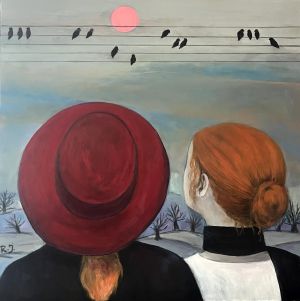
Mirjam Zunser
1 January 1912 | Dresden – 20 October 1969 | Munich
Violinist & flutist
Tanja Ury (née Zunser)
3 January 1907 | Dresden – 15 January 1988 | Lafayette, USA
Pianist
Mirjam – the younger of the two sisters in the Zunser family – discovered her talent for the violin at an early age and received tuition from renowned teachers, including Jan Dahmen of the Dresden Staatskapelle and the violinists Karl Flesch and Adolf Busch. In 1929, she continued her training in Leipzig, funded by a scholarship from Breslau and the support of her parents. Mirjam studied at the University of Music – then known as the State Conservatoire – under Prof. Walther Davisson, a violinist and conductor. He was her principal subject tutor. Leipzig – one of the most important centres of music at that time – thus became a formative place in her artistic development.
Despite her immense talent and the offers she received, the rise to power of the National Socialists in 1933 prevented Mirjam from giving public concerts. Under the Nazi regime, artistic performances were restricted to Jewish associations. Thus, in 1933, she played, amongst other venues, in the White Hall of the Zoo in aid of an Israelite nursery school.
In the Collegium musicum of Jewish music lovers – which took part in events organised by the Jewish Cultural Association – she became concertmaster. She also performed in various chamber music ensembles – often alongside her sister, the pianist Tanja Ury Zunser. A diverse Jewish cultural life was able to endure in Leipzig – rooted in the strong solidarity and resilience of those involved. In this environment, Mirjam was highly regarded as a musician.
On 5 May 1938, Mirjam gave her last concert in Leipzig and went into exile in England – later moving to the USA. In 1960, she returned to Leipzig. At her former place of study (now the ‘Felix Mendelssohn Bartholdy’ University of Music), she took up a teaching post in violin. A year later, however – during a politically turbulent period – she left Leipzig once more and went to Vienna. ‘This is where the trail of Mirjam Zunser goes cold,’ reads the ‘Entdeckerpass’ information sheet on Jewish musicians in Leipzig. ‘All that is known is that Mirjam Zunser probably took her own life in Munich eight years later.’
NOTE: *) Due to the nature of the exhibition format, the biographical details mentioned above had to be abridged. Visitors to the exhibition have the opportunity to read an expanded version of the biographical details in the exhibition folders provided. The entire, very extensive project includes further biographies, additional content and research … is in progress – also online…